|
|
|
Getting the Water From the Pool of Siloah |
Hope of Israel Ministries (Ecclesia of YEHOVAH):
The Three Most Important Events During the Feast of Tabernacles
|
The celebration of the Water-drawing was a highlight of the Feast of Tabernacles. It was a happy, even ecstatic occasion, with a torchlight parade, including musicians, jugglers, and dancers, marching to the Temple at night, as the whole city of Jerusalem was lit up by giant torches and the light of the four giant Temple menorahs. The lighting of the four immense menorahs on the first Holy Day of the Feast of Tabernacles points to the fact that the Shekinah Glory of YEHOVAH God will return on this SAME DAY in the near future! |
by John D. Keyser
The Feast of Tabernacles was considered the most joyous season of the entire year. With all the electric anticipation along the caravan trails, the stirring religious ceremonies, the inspiring singing of hymns, and the Levitical choir and orchestra playing at the Temple, with lively singing, dancing, and feasting, the joy literally ran over the brim. During this most joyous time three events stand out with great prophetic significance. They are:
(1) The Pouring Out of Water:
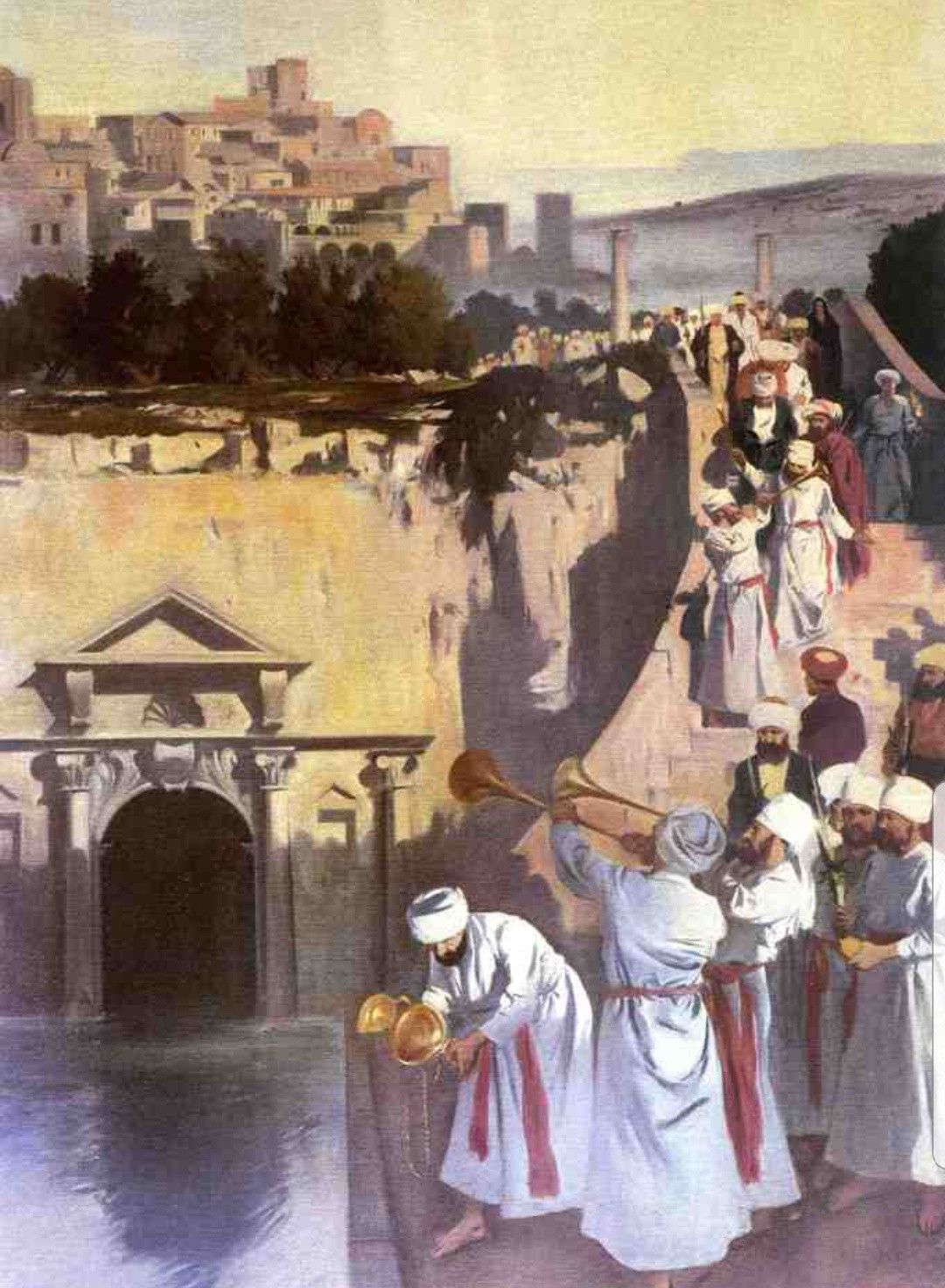
Each day of the Feast, a vital celebration took place called Simkhat Beit Hashoavah, that is, "The Rejoicing at the Place of the Water-Drawing."
"Each morning of Sukkot, the priests went to the pool of Siloah (Silwan) near Jerusalem to fill a golden flask. Shofar blasts greeted their arrival at the Temple's Water Gate. They then ascended and poured the water so that it flowed over the altar simultaneously with wine from another bowl. When the priest was about to pour the water, the people shouted 'Raise your hand!' because of an incident that occurred in a previous year: The high priest Alexander Jannaeus (103-76 B.C.E.) showed contempt for the rite by spilling the water at his feet, a transgression for which worshippers threw their citrons at him.
"The pelted priest had demonstrated his alliance with the Sadducees, who literally followed Torah and only what was specifically in Torah. (Explained as an oral instruction given to Moses at Sinai, this water rite was not mentioned in The Five Books.) The deliriously happy celebration connected with the water drawing developed when the Pharisees (who believed in the Oral Tradition and interpretation of Torah and gave us the rabbinic Judaism we know today) triumphed over them in the first century.
"Based on Isaiah's promise 'With joy shall you draw water out of the wells of salvation' (12:3), rejoicing began at the end of the first day and took place every night except Shabbat. The Talmud recorded that 'one who had never witnessed the Rejoicing of the Place of the Water Drawing has never seen true joy in his life.' (Although the celebration was for the libation that would be made the next morning, it was named for the preparation for the ritual -- the water drawing -- which the rabbis said showed that getting ready was sometimes of greater merit than the mitzvah itself because of its positive effect on the person doing it)" (Simchat Beit Hashoavah: The Water-Drawing Festival | My Jewish Learning).
|
|
|
Getting the Water From the Pool of Siloah |
Why was this ceremony called "The Water-Drawing Ceremony"? Alfred Edersheim gives us the emphatic reason, as understood by the Rabbis. He writes:
"For though that ceremony was considered by the Rabbis as being a subordinate reference to the dispensation of the rain, the annual fall of which they they imagined was determined by God at that feast, its main and real application was to the future outpouring of the Holy Spirit, as predicted -- probably in allusion to this very rite -- by Isaiah the prophet. Thus the Talmud says distinctly: 'Why is the name of it called, The drawing out of water? Because of the pouring out of the Holy Spirit, according to what is said: 'With joy shall ye draw waters out of the well of salvation.' Hence, also, the feast and the peculiar joyousness of it, are alike designated as those of 'the drawing out of water'; for according to the same Rabbinical authorities, the Holy Spirit dwells in man [of Israel] only through joy" (The Temple, p. 279-280).
(2) The Daily Circuit of the Altar:
A similar symbolism was expressed by another ceremony that took place at the close of the daily sacrifices during the Feast -- notice:
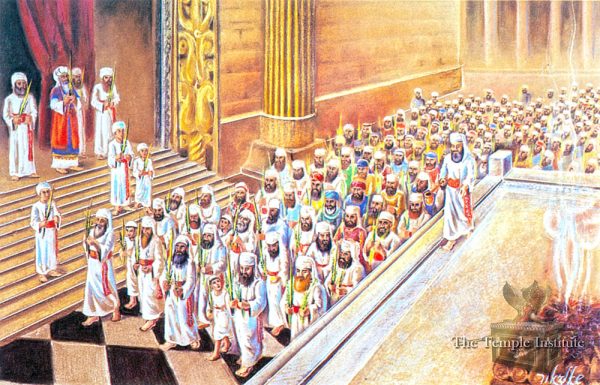
"On every one of the seven days the priests formed in procession, and made the circuit of the altar, singing: 'O then, now work salvation, Jehovah! O Jehovah, give prosperity! [Psalm 118:25] But on the seventh, 'that great day of the feast,' they made the circuit of the altar seven times, remembering how the walls of Jericho had fallen in similar circumstances, and anticipating how, by the direct interposition of God, the walls of heathenism would fall before Jehovah, and the land lie open for His people [Israel] to go in and possess it" (Ibid., p. 280).
Edersheim goes into greater detail in his general work entitled, The Life and Times of Jesus the Messiah:
"In further symbolism of this Feast [of Tabernacles], as pointing to the ingathering of the...[Israelite] nations, the public services [for the first six days] closed with a procession round the Altar by the Priests, who chanted 'O then, work now salvation, Jehovah! O Jehovah, send now prosperity.' But on the last, the Great Day of the Feast, this procession of Priests made the circuit of the Altar, not only once, but seven times, as if they were again compassing, but now with prayer, the Gentile Jericho which barred their possession of the promised land. Hence the seventh or last day of the Feast was also called that of the Great Hosannah. As the people left the Temple, they saluted the Altar with words of thanks, and on the last day of the Feast they shook off the leaves on the willow-branches round the Altar, and beat their palm-branches to pieces. On the same afternoon the booths [tabernacles or sukkah] were dismantled, and the Feast ended" (Part 2, pp. 159-160).
It was on this last day of the Feast of Tabernacles that Yeshua the Messiah stood up in the Temple and cried, "If any one thirst, let Him come into me and drink!" This had special reference to the ceremony of the out-pouring of the water, which was considered the central part of the service. All the Israelites at the time understood that the Messiah's words referred to the holy spirit, since the rite was universally regarded in Judea and Diaspora as symbolic of YEHOVAH God's outpouring.
|
|
|
Circling the Temple Altar |
(3) The Illumination of the Temple Ceremony:
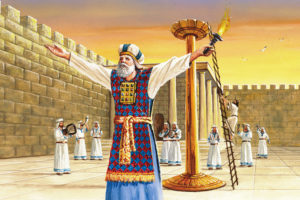
As a part of this fascinating ceremony, four immense menorahs were set in the Temple courtyard for the Feast of Sukkot, 75 feet in height. Each menorah had four golden bowls and was reached by four ladders. Each bowl was capable of holding many gallons of oil. Four youths of priestly descent each held a pitcher of oil, which they used to fill the bowls. Wicks were made from the old, cast-off priestly garments and rags from worn-out vestments. When the menorahs were lit, they generated such intense and brilliant light, that not a courtyard in the whole city of Jerusalem failed to be illuminated by the blazing light. Notice Edersheim's description of it --
"At the close of the first day of the feast the worshippers descended to the Court of the Women, where great preparations had been made. Four golden candelabras were there, each with four golden bowls, and against them rested four ladders; and four youths of priestly descent held, each a pitcher of oil, capable of holding one hundred and twenty log, from which they filled each bowl. The old, worn breeches and girdles of the priests served for wicks to these lamps. There was not a court in Jerusalem that was not lit up by the light of 'the house of water-pouring'" (ibid., p. 283).
|
|
|
Lighting the Huge Temple Menorahs During Tabernacles |
What did these four immense candelabrum or menorahs that lit up the whole city of Jerusalem symbolize? Edersheim explains:
"It seems clear that this illumination of the Temple was regarded as forming part of, and having the same symbolic meaning as, 'the pouring out of water.' The light shining out of the Temple into the darkness around, and lighting up every court in Jerusalem, must have been intended as A SYMBOL...OF THE SHECKINAH [GLORY] which once filled the Temple" (The Temple, p. 285).
YEHOVAH's Presence in the Temple
While Edersheim says that the Shekinah Glory "once filled the Temple," implying that It wasn't there during the Messiah's day, there is abundant evidence to show that YEHOVAH God's Shekinah Glory was indeed resident in the Second Temple during the time of the Messiah -- and up to just before the destruction of Jerusalem and the Temple in 70 A.D.
When Yeshua the Messiah was crucified on the tree facing the Holy of Holies from the site of the Red Heifer sacrifice on the Mount of Olives, he cried out, "Eloi, Eloi, lama sabachthani?," which is translated, "My God, My God, why have You forsaken me?" (Mark 15:34). He sensed that YEHOVAH God's Shekinah Glory in the Temple had turned away from him at that very moment, evoking the heart-wrenching cry that was followed by "'Father, into Your hands I commend my spirit.' And having said this, he breathed his last." (Luke 23:46) The Messiah knew that his Father's Shekinah Glory was present in the Holy of Holies of the Temple.
YEHOVAH's Shekinah Glory remained in the Temple all through the life and death of the Messiah and up to the year 66 A.D., when it was seen leaving the Temple and alighting on the Mount of Olives. Relates Ernest L. Martin:
"There is another reason why Christians in the first century were very interested in the Mount of Olives. This is because it was believed that the Shekinah Glory of God which...dwelt inside the Holy of Holies at the Temple left the sanctuary and went to the Mount of Olives and hovered over that spot at the time of the Roman/Jewish War which ended in A.D. 70" (Secrets of Golgotha, ASK Publications, Alhambra, CA, p. 83).
Eusebius, an early church father (260?-340?) wrote in his book Proof of the Gospel that
"...believers in Christ congregate from all parts of the world...that they may worship at the Mount of Olives opposite to the city, whither the glory [the Shekinah Glory] of the LORD [YEHOVAH, YHVH] migrated when it left the former city" (Book VI, Chapter 18 (288)).
According to Eusebius the Shekinah Glory left the Temple and hovered over the Mount of Olives during "the siege of Jerusalem" (66 A.D. to 70 A.D.). Also, a Jewish rabbi named Jonathan -- who was an eyewitness to the destruction of Jerusalem -- said that the Shekinah Glory left the Temple and for three and a half years,
"...abode on the Mount of Olives hoping that Israel would repent, but they did not; while a Bet Kol [a supernatural voice] issued forth announcing, Return, O backsliding children [Jeremiah 3:14]. Return unto Me, and I will return unto you [Malachi 3:7], when they did not repent, it said, I will return to My place [Hosea 5:15]" (Midrash Rabbah, Lamentations 2:11).
Josephus, 1st-century Jewish historian, mentioned that in the Spring of 66 A.D. some astonishing events took place within the Temple. He recorded three miracles associated with YEHOVAH's Shekinah Glory and the Temple -- and each one clearly showed that the Shekinah Glory of YEHOVAH God was departing from the Holy of Holies. In Wars VI, 290 he stated that "a great light shone over the altar for thirty minutes at 3 o'clock in the morning (a week before Passover in A.D. 66) and then it departed." He said the sacred scribes interpreted this sign as a bad omen for the Temple. It was like the Shekinah Glory moving away from the Tabernacle in the wilderness as a sign to disassemble the Tabernacle and transport it to another location.
The second miracle concerned the Temple gates: "...a few days later (during Passover itself) the enormous brass gates of Nicanor, requiring twenty men to open and close them, opened at midnight of their own accord" (Wars VI, 293-295). Then, about one hundred days later, on Pentecost, the final sign was given that definitely showed that the Shekinah Glory was departing the Temple, as the other signs indicated. Notice!
"Moreover, at the festival which is called Pentecost, the priests on entering the inner court of the Temple at nightfall, as their custom was in accomplishment of their ministrations, stated that they first became aware of a commotion and a roar, and after that the voice of a great multitude saying 'We are departing hence'" (Wars VI, 299)
When we couple all this information together it is quite apparent that YEHOVAH's Shekinah Glory was in residence in the Holy of Holies during at least the lifetime of the Messiah and up to within a few years of the Temple's destruction in 70 A.D.
This being the case, the ceremony of lighting the four menorahs in the Court of the Women must POINT TO SOME FUTURE EVENT! What could this future event be? None other than the RETURN OF YEHOVAH GOD'S SHEKINAH GLORY TO JERUSALEM AND THE TEMPLE! Edersheim records that "...according to Jewish tradition, the pillar of cloud by day and of fire by night [the Shekinah Glory of YEHOVAH God] had first appeared to Israel on the 15th of Tishri, the first day of the feast....[and] we know that the dedication of Solomon's Temple and the DESCENT OF THE SHECHINAH took place at this feast" (The Temple, p. 286).
What the Prophets Said
James D. Tabor writes that "...the Hebrew Prophets constantly emphasize the dramatic, awesome, earth-shaking, personal return of YHVH [YEHOVAH] Himself to this planet. They clearly intend to convey an actual, literal, historical event in the future, something that will be experienced by all the inhabitants of the earth" (Restoring Abrahamic Faith, pp. 70-71). We read of this in Zechariah 14:1-4, 5, 9, 16:
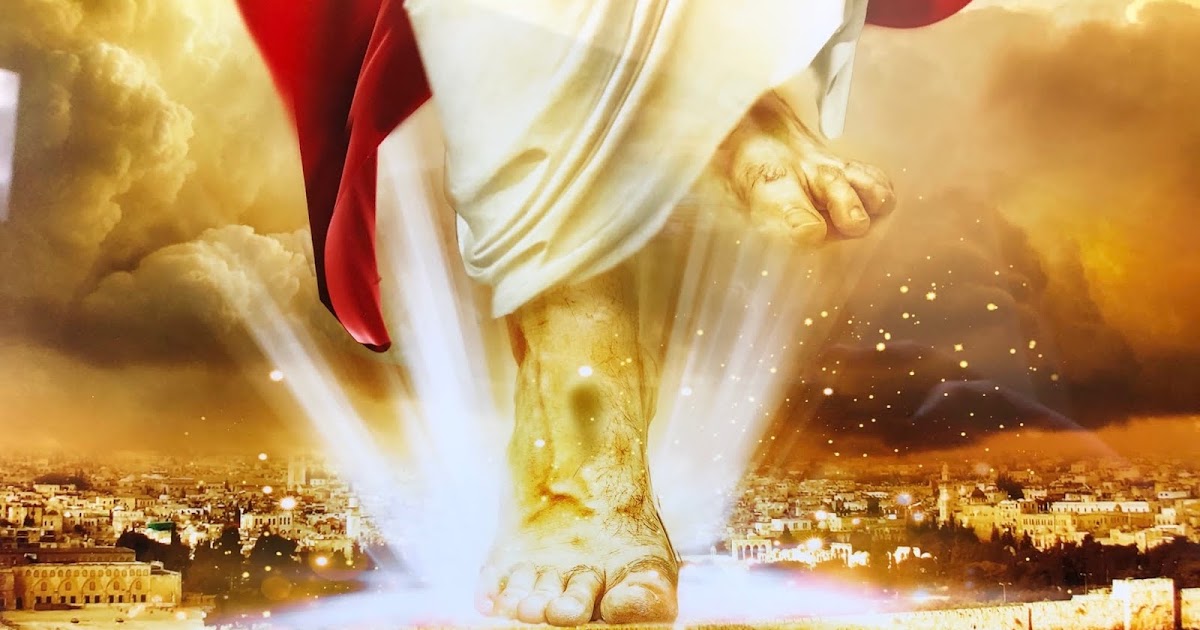
"Behold, the day of YEHOVAH is coming, when the spoil taken from you will be divided in the midst of you. For I will gather all the nations against Jerusalem to battle, and the city shall be taken and the houses plundered and the women ravished; half of the city shall go into exile, but the rest of the people shall not be cut off from the city. Then YEHOVAH will go forth and fight against those nations as when he fights on a day of battle. On that day HIS FEET SHALL SHALL STAND ON THE MOUNT OF OLIVES which lies before Jerusalem on the east....
"Thus YEHOVAH my God will come, and all the saints [of Israel] with You....And YEHOVAH will become King over all the earth; on that day YEHOVAH will be one and His Name one....Then every one that survives of all the nations that have come against Jerusalem shall go up year after year to worship the King, YEHOVAH of Hosts, and to keep the feast of booths" (RSV).
|
|
|
On That Day YEHOVAH's Feet Shall Stand On the Mount of Olives (Zechariah 14:4) |
This prophecy contains a number of remarkable features that emphasize the fact that YEHOVAH God Himself will directly intervene and become King over the entire earth. Writes Tabor:
"The entire focus of the text is upon YHVH [YEHOVAH] God. I emphasize this point, not to deny or even downplay the role of [the] Messiah, but rather to stress that Zechariah is able to offer this rather detailed scenario of the 'end of the age,' and the arrival of the Kingdom of God without once mentioning the role of the Davidic King [Yeshua the Messiah]. Also, despite any use of symbolic or metaphorical language (i.e., His feet standing on the Mt. of Olives), the passage is full of historical and geographical details. The prophet obviously intends to describe an actual, literal, historical event in the future history of Israel and Jerusalem. The language itself resists allegorical interpretation" (Restoring Abrahamic Faith, p. 71).
Throughout the Old Testament the Prophets constantly make the point that YEHOVAH God Himself (in the form of His Shekinah Glory) will come down from Heaven and intervene in the affairs of this world, acting personally and directly, to punish the wicked and RULE AS KING OVER ALL NATIONS. Many have assigned this role to the Messiah, a huge mistake that the churches of this world continue to promulgate. Following are some of the many verses in the Old Testament that underscore the role of YEHOVAH God ON THIS EARTH in the very near future! Notice:
"Come my people, enter your chambers, and shut your doors behind you; hide yourself, as it were, for a little moment, until the indignation is past. For behold, YEHOVAH comes out of His place [Heaven] to punish the inhabitants of the earth for their iniquity; the earth will also disclose her blood, and will no more cover her slain" (Isaiah 26:20-21).
"Behold, YEHOVAH makes the earth empty and makes it waste, distorts its surface, and scatters abroad its inhabitants....They shall lift up their voice, they shall sing; for the majesty of YEHOVAH they shall cry aloud from the sea. Therefore glorify YEHOVAH in the dawning light, the name of YEHOVAH God of Israel in the coastlands of the sea....It shall come to pass on that day, that YEHOVAH will punish on high the host of exalted ones, and on the earth the kings of the earth....Then the moon will be disgraced and the sun ashamed, For YEHOVAH of Hosts will reign on Mount Zion and in Jerusalem, and before His elders gloriously" (Isaiah 24:1, 14-15, 21-23).
"A voice cries, 'Prepare the way for YEHOVAH in the wilderness; make straight in the desert a highway for our God. Every valley shall be exalted and every mountain and hill brought low; the crooked places shall be made straight and the rough places smooth; the [Shekinah] Glory of YEHOVAH will be revealed, and all flesh will see it together; for the mouth of YEHOVAH has spoken'" (Isaiah 40:3-5).
Then, in Isaiah 40:9-11:
"O Zion, you who bring good tidings, get up into the high mountain; O Jerusalem, you who bring good tidings, lift up your voice with strength, lift up and be not afraid: Say to the cities of Judah, 'Behold your God!' Behold LORD YEHOVAH shall come with a strong hand, and His arm shall rule for Him; behold, His reward is with Him and His work before Him. He will feed His flock like a shepherd; He will gather the lambs with His arm, and carry them in His bosom, and gently lead those who are with young.'
"How beautiful upon the mountains are the feet of him who brings good news, who proclaims peace, who brings glad tidings of good things, who proclaims salvation, who says to Zion, 'Your God reigns!' Your watchmen shall lift up their voices, with their voices they shall sing together; for they shall see eye to eye when YEHOVAH brings back Zion....YEHOVAH has made bare His holy arm in the sight of all the nations; and all the ends of the earth shall see the salvation of our God" (Isaiah 52:7-8, 10).
In an obvious fulfillment of the the Water-Drawing Ceremony, the prophet Ezekiel makes the following comment:
"For I [YEHOVAH God] will take you [modern Israelites] from among the nations, gather you out of all the countries, and bring you into your own land. Then I will SPRINKLE CLEAN WATER ON YOU, and you shall be clean...I will give you a new heart and out a new spirit within you...." (Ezekiel 36:25-26).
"And I will not hide my face from them anymore; for I shall have poured out My spirit on the house of Israel" (Ezekiel 39:29).
The Garment Soaked in Blood
In Isaiah 63 we find imagery that is duplicated in the New Testament, leading us to a startling conclusion -- notice!
"Who is this who comes from Edom, with DYED GARMENTS from Bozrah, this One who is glorious in His apparel, traveling in the greatness of His strength? 'I who speak in righteousness, mighty to save.' WHY IS YOUR APPAREL RED, AND YOUR GARMENTS LIKE ONE WHO TREADS IN THE WINEPRESS? 'I have trodden the wine press alone, and from the peoples no one was with Me. For I have trodden them in My anger, and trampled them in My fury; THEIR BLOOD IS SPRINKLED ON MY GARMENTS, and I have stained all My robes. For the day of vengeance is in My heart, and the year of My redemption has come. I looked, and there was no one to help, and I wondered and there was no one to uphold; therefore My own arm brought salvation to Me; and My own fury, it sustained Me. I have trodden down the peoples in My anger, made them drunk in My fury, and brought down their strength to the earth'" (Isaiah 63:1-6).
Also, in Isaiah 66: 15-16:
"For behold, YEHOVAH will come with fire and with His chariots, like a whirlwind, to render His anger with fury, and His rebuke with flames of fire. For by fire and by His sword YEHOVAH will judge all flesh; and those slain by YEHOVAH will be many."
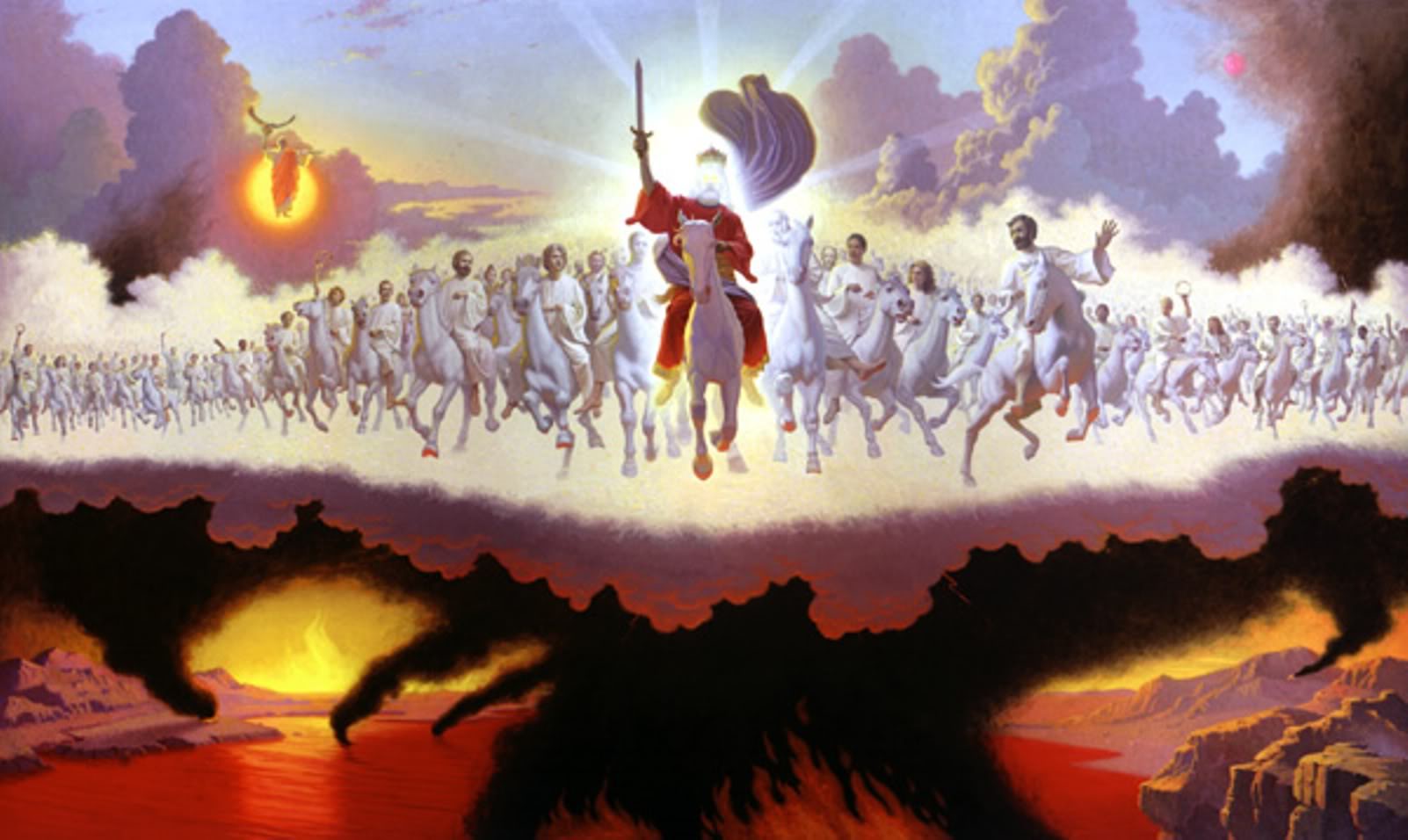
In Revelation 19 -- in the New Testament -- we find similar wording and imagery that clearly shows the Being on the white horse to be YEHOVAH God -- NOT the Messiah as millions have believed over the centuries! Compare!
"Then I heard what sounded like the roar of a huge crowd, like the sound of rushing waters, like loud peals of thunder, saying, 'Halleluyah! YEHOVAH, God of heaven's armies, has begun His reign!'....Then I saw heaven opened, and there before me was a white horse. Sitting on it was the One called Faithful and True, and it is in righteousness that He passes judgment and goes to battle. His eyes were LIKE FIERY FLAME, and on his head were many royal crowns. And He had a Name written which no one knew but Himself. HE WAS WEARING A ROBE THAT HAD BEEN SOAKED IN BLOOD, and the Name by which He is called is, 'THE WORD OF GOD.' The armies of heaven, clothed in fine linen, white and pure, were following Him on white horses. And out of His mouth comes A SHARP SWORD with which to strike down nations -- 'HE WILL RULE THEM WITH A STAFF OF IRON.' IT IS HE WHO TREADS THE WINEPRESS from which flows the wine of the furious rage of YEHOVAH, God of heaven's armies. And on His robe and on His thigh He has a name written: 'KING OF KINGS AND LORD OF LORDS'" (Revelation 19:6; 11-16, Jewish New Testament)
It can be demonstrated that "THE WORD OF GOD" -- referred to in the above passage -- is none other than the Shekinah Glory of YEHOVAH God! See our article, The Return of YEHOVAH God and His Messiah! Also, the phrase "King of kings and Lord of lords" can only refer to YEHOVAH God -- He is the ultimate King and the ultimate Lord -- there is "none other above Me." Explains James Tabor:
"Too often Christians allow themselves to hastily run through such texts, all the while assuming that when the Prophets speak of YHVH [YEHOVAH] Himself acting in such decisive ways they actually refer to His Messiah. How often I have heard preachers say 'When Jesus returns, his feet will stand on the Mt. of Olives.' This is unfortunate and CARELESS EXEGESIS. As one can plainly see, through a careful reading of all these texts, the Prophets always maintain a clear distinction between [the] dramatic appearance of the LORD God (YHVH) and [the] Davidic rule of the Messiah" (Restoring Abrahamic Faith, p. 74).
|
|
|
The Return of YEHOVAH God With the Saints |
Continues Tabor:
"To understand this teaching of Scripture one has to make a distinction between the general presence of God, which is always with His creation, and this very specific, literal, awesome, visible, manifestation of the Divine Glory. In that sense God DEPARTED from this planet [just prior to the destruction of Jerusalem in 70 A.D.], and in that sense the Prophets all tell of HIS RETURN. In other words, the Prophets predict a visible, awesome, literal, manifestation of the [Shekinah] Glory of YHVH [YEHOVAH] once again" (ibid., p. 75).
The Light of the Israelite World
This is what the lighting of the four immense menorahs on the first Holy Day of the Feast of Tabernacles points to! The fact that the Shekinah Glory of YEHOVAH God descended and filled Solomon's Temple at it's dedication on this day, and the fact that the pillar of cloud by day and of fire by night first appeared to the Israelites under Moses on the 15th of Tishri, clearly point to the return of YEHOVAH's Shekinah Glory on this SAME DAY in the near future! This is why the menorahs were lit at this time during the Water-Drawing Ceremony. When the Shekinah Glory returns there will be a future outpouring of the holy spirit upon those of Israel as predicted by this very rite.
This celebration was so brilliant that the people called it "The Light of the World." To the Israelites of the time the term "world" meant the world of Israel -- not the entire planet and all its people. Now let’s look at John 8:12:
"Yeshua spoke to them again: 'I am the light of the world [of Israel]; whosoever follows me will never walk in darkness but will have the light which gives life'” (Jewish New Testament).
When the Messiah made this statement all the people knew exactly what he was referring to. The huge Temple menorahs were the light of the entire surrounding area. Even though the Messiah was away from Palestine for many years, it is evident that even from childhood Yeshua could clearly remember the spectacle of the lights of these huge menorahs. Who could forget it?
If we look in John 9:1-7 we will see how the Messiah not only talked about being the light of Israel, he actually gave the light of Israel to a blind man near the Temple gate. Records John 9:1-7:
"As Yeshua passed along, he saw a man blind from birth. His talmidim [disciples] asked him, 'Rabbi, who sinned -- this man or his parents -- to cause him to be born blind?' Yeshua answered, 'His blindness is due neither to his sin nor to that of his parents; it happened so that God's power might be seen at work in him. As long as it is day, we must keep doing the work of the One [YEHOVAH God] who sent me; the night is coming, when no one can work. While I am in the [Israelite] world, I am the light of the world.' Having said this, he spit on the ground, made some mud with the saliva, put the mud on the man's eyes, and said to him, 'Go, wash off in the Pool of Shiloach [Siloam]! (The name means 'sent.') So he went and washed and came away seeing" (ibid.).
Then, in James 1:17, we read: "Every good thing given and every perfect gift is from above, coming down from the Father of lights, with whom there is no variation or shifting shadow.” The Messiah was not only the light of Israel, but he also gave light to a blind man on the Last Great Day, the 22nd, as revealed in John 9:14: "Now it was a Sabbath on the day when Yeshua made the clay, and opened his eyes."
The apostle Paul applies this to those of us of Israel when he said in Philippians 2:14-15: "Do all things without murmuring and disputing, that you may become blameless and harmless, children of God without fault in the midst of a crooked and perverse generation, among whom you shine as lights in the world...”
As the four mighty menorahs blazed in the night, we read:
"A Levite orchestra of flutes, trumpets, harps, and cymbals accompanied torchlight processions, and men who had earned the capacity for real spiritual joy through their purity, character and scholarship danced ecstatically to the hand-clapping, foot-stomping, and hymn-singing crowds.
"We do not imagine our distinguished sages as acrobats and tumblers, but they were often agile physically as well as mentally. Rabbi Simon ben Gamaliel juggled eight lighted torches and raised himself into a handstand on two fingers, a gymnastic feat no one else could master. Others juggled eight knives, eight glasses of wine, or eight eggs before leaders and dignitaries" (Simchat Beit Hashoavah: The Water-Drawing Festival | My Jewish Learning).
The celebration of the Water-drawing was a highlight of the Feast. It was a happy, even ecstatic occasion, with a torchlight parade, including musicians, jugglers, and dancers, marching to the Temple at night, as the whole city of Jerusalem was lit up by giant torches and the light of the four giant menorahs. As the lyres, drums, cymbals, trumpets, drums, and horns played, the Rabbis entertained and clowned, adding to the joy. Not one day of Sukkot passed without joyous festivities that celebrated the happiness of the harvest and the joy of community.
As the dawn of each day approached, the priests descended the steps to the Women's Court, with trumpets blaring. They marched in procession to the Eastern Gate of the Temple, then turned their faces toward the Temple (to the west) and proclaimed, "Our fathers who were in this place stood with their backs to the Temple and their faces eastward and worshipped the sun. but our eyes are unto the LORD" (based on Ezekiel 8:16).
It should be noted that two of the three most important ceremonies of the Feast of Tabernacle -- the pouring out of water and the illumination of the Temple -- were of post-Mosaic origin. According to Jewish tradition, the pillar of cloud by day and of fire by night had first appeared to the Israelites on the 15th of Tishri, the first day of the Feast of Tabernacles. Also, on that day, Moses was said to have come down from Mount Sinai, and announced to the people that the Tabernacle of YEHOVAH God was to be reared up among them. We know that the dedication of Solomon's Temple and the descent of YEHOVAH God's Shekinah Glory took place at the time of this Feast day.
We also find an allusion to the water-pouring ceremony and the Messiah's outburst in the Temple in Revelation 7:9-10,
"After these things I looked, and behold, a great multitude which no one could number, of all nations, tribes, peoples, and tongues [of Israel], standing before the throne [of YEHOVAH God] and before the Lamb [the Messiah], clothed with white robes, with palm branches in their hands, and crying out with a loud voice, saying, 'Salvation belongs to our God who sits on the throne, and to the Lamb!"
The main fact remains that the Feast of Tabernacles is the one and only type in the Old Testament that has not yet been fulfilled.
| Hope of Israel Ministries -- Bringing YEHOVAH's Truth to His Israel People |
|
Hope of Israel
Ministries |
|
Scan with your Smartphone for more information |