|
|
Hope of Israel Ministries (Ecclesia of YEHOVAH):
The Coming Great Depression
|
The writing is on the wall. In the last decade, the frantic efforts of central banks around the world to keep pumping new money (new debt) into the system has not worked. Zero interest rates, and even negative interest rates in some countries, along with trillions of dollars and euros and yen in “quantitative easing” has still not resulted in “economic recovery.” The reality is that the whole thing is a confidence trick! But until the music stops, as long as people keep borrowing and spending and racking up more and more debt, the doomed system continues, but with debt (to the banks) rising exponentially. The next “Great Depression” is not a matter of “if.” It is only a matter of “when.” And all indications are that it will be sooner rather than later. |
by Graham Dyer
(“The merchants of the earth will weep and mourn over her because no one buys their cargoes anymore -- cargoes of gold, silver, precious stones and pearls; fine linen, purple, silk and scarlet cloth; every sort of citron wood, and articles of every kind made of ivory, costly wood, bronze, iron and marble; cargoes of cinnamon and spice, of incense, myrrh and frankincense, of wine and olive oil, of fine flour and wheat; cattle and sheep; horses and carriages; and human beings sold as slaves. They will say, ‘The fruit you longed for is gone from you. All your luxury and splendor have vanished, never to be recovered.’ The merchants who sold these things and gained their wealth from her will stand far off, terrified at her torment. They will weep and mourn” (Revelation 18:11-15).)
Two things combine to make a historic global economic downturn a certainty. Each on its own is sufficient to create havoc in financial markets that will lead to devastating consequences for the global economy that could be worse than the 1930s. Put them together and they become a lethal cocktail for which there is no antidote.
I am constantly blown away that others can’t see these two things. But economists didn’t even identify the last Great Depression as such until 1933, four years after the wake-up call that came in the form of the 1929 stock market crash. So we should not be surprised if they can’t see this one coming.
The two things that make the next “Great Depression” a certainty are:
1). The natural, cyclical socionomic force that drives human crowds. A long wave of pessimism must follow the long wave of optimism that we have experienced since 1932, just as surely as night follows day. “Nature” cannot be defied. Fighting against the natural socionomic force that drives humankind in financial markets and socially and culturally is just as futile as trying to defy the natural force of gravity.
2). Our fraudulent, deliberately flawed, interest burdened debt money system has passed its use-by date and must implode. It has the seeds of its own destruction sewn within it. The unsustainable mountain of debt to banks that had built up during the preceding eight decades is what led to the “global financial crisis” in 2008. In a futile attempt to extend the life of this fatally flawed system central banks and governments have only built the debt mountain trillions of dollars higher, so that the inevitable end game will now be much worse than it would have been if “Nature” had been allowed to run its course in 2008. It is a “skyscraper of cards held together with Band Aids.”
If these revelations are new to you, I will now explain them in more detail.
Socionomics -- The Unconscious Urge to Herd
The good news is that we should be able to read the warning signs before a historic downturn occurs.
“The Rhythm of the Universe”
Everything in the universe is cyclical. Some cycles are precise (e.g. tide times, moon phases, days, years, etc.) Others are “robust” (e.g. seasons, weather patterns, etc.) Even though you may not know in advance on which days it will snow in New York or Berlin, you know it will be in January or February, not July or August, because snow season (in the northern hemisphere), like everything else in the universe, comes in regular, identifiable cycles, even though they may not be precise. Likewise the blooming time for cherry blossoms in Tokyo may begin in late March rather than early April, but you know it won’t be in September.
Not only physical things are cyclical. Fashions are cyclical. Movie and music genres are cyclical. The width of neck ties and trousers and cuffs is cyclical. Why is this? It is because human crowd mood and emotion is also cyclical. I refer to the socionomic force that drives the “herd” in the share market, the property market, the gold market, etc. In fact it drives the herd in everything, including the economy and social interaction. The unconscious urge to herd means that everyone does the same thing at the same time, without realizing that is what is going on. There is some invisible, unconscious connection between us all that makes everyone do the same thing at the same time.
In his 1841 book Extraordinary Popular Delusions and the Madness of Crowds, writer Charles Mackay quotes the ancient German philosopher Friedrich Schiller:
“Anyone taken as an individual is tolerably sensible … as a member of a crowd, he at once becomes a blockhead.”
Bernard Baruch (1870–1965), famous American financier and presidential adviser, is reported to have avoided losing millions in the 1929 stock market crash by remembering this important truth. He later said:
“All economic movements, by their very nature, are motivated by crowd psychology, which has the power to unexpectedly affect any static condition or so called normal trend.”
I won’t go into a great deal of detail here. I merely want to introduce you to what may be a whole new world for you. However, I will just briefly illustrate how the unconscious urge to herd can be manifest in daily life. Only after I began to understand the socionomic force did I notice these two things.
I am not a phone person. I have been like that all my life. In fact, I may go weeks without making a single phone call, unless I lose my wife in a shopping center, or I need to call her to ask if she wants me to pick up bread and milk on the way home, or something else important like that. I rarely use a phone. Consequently not many people call me.
Many times I have noticed this phenomenon: My landline phone might ring, for the first time in a week or maybe weeks. Within seconds of answering the call I hear “beep beep” on the line, advising me that another caller is waiting. Then, while I am trying to handle both of those calls, my mobile phone rings. Those three callers do not even know each other. One may be from the Gold Coast, one from Melbourne, and the other one from overseas. Why did they all decide to call me at that same precise moment? If this happened just once I would consider it coincidental. But because I am now conscious of this phenomenon I have noticed it many times.
I used to have a chain of retail shops. Most were run by just one manager. Some days, even weeks, business might be so quiet that my employee may spend most of the day shuffling stock just to try and keep busy. Then suddenly a customer would come into the shop; then another; and another. Within minutes it might be standing room only in my little shop, with the manager unable to attend to all the customers waiting. None of these customers knew each other. There is no “reason” why they all turned up in my little shop at the same time. It may be 11 am on a Tuesday or 3 pm on a Friday. Within half an hour the rush is over and it becomes dead quiet again. Why did all those people, from diverse places, unknown to each other, all come in to my little shop at the very same time? Again, if this happened once I would regard it as a coincidence. But I have seen it many times.
I cannot explain, in scientific terms, the invisible connection between us all and the force that drives the unconscious impulse to herd. But I am in awe of it. And the fact that it produces patterns of crowd behavior, especially in financial markets, is beyond awesome to me. I am sure it is part of the unfathomable “rhythm of the universe.” In the context of this paper it provides us with a unique tool for forecasting financial markets and economic and social and cultural trends.
The herd, the crowd, the public, whatever you want to call the human mass of
society, progresses through history in waves of optimism which are punctuated by
waves of pessimism. We are like the worm, which can only go forward so far
before he has to pull back. Only after he has pulled back and gathered himself
together can he go forward again.
Humans as a collective or “herd” are the same. We move forward in a wave of
optimism. But that optimism has to be interrupted by a wave of pessimism, during
which we regress, economically, socially and culturally, before we can resume
our optimism and go forward again. As individuals we are not conscious of this.
But as part of a crowd we unconsciously do what everyone else is doing, and at
the same time. We all change our unconscious mood at the same time, from
optimism to pessimism and back again. Regular crowd mood changes are natural and
cyclical.
Even economists, whom I irreverently refer to as “The Flat Earth Society,” (which includes the media that reports them, and everyone else, including governments and central banks, who follow them), acknowledge the “business cycle.” Yet they do not know, nor have they any interest in finding out, what causes that cycle.
Unconscious Urge (emotion) vs. Logic
Consider how the unconscious urge to herd affects us in making investment decisions.
I often say to my clients there is only one rule in investing. You buy when the price is low; you sell when the price is high. It’s that simple. But it is human nature to do the opposite. That is because of our unconscious urge to herd.
For example, take the real estate market. When house prices are low and have not moved for years (e.g. early 1990s in Australia), property becomes a dirty word. Nobody wants to invest in real estate. The media doesn’t want to know about it. Reality TV programs about buying or selling or renovating houses are not even produced, because they would not rate.
But once house prices have doubled, these programs start to appear, and “everyone” becomes interested in property investment. By the time house prices have tripled, every man and his dog wants in, TV shows about real estate rate through the roof, and people take on mind blowing risk to get into the property market before they “miss out.” Miss out on what? A certain loss when prices fall again?
The Share Market
Look at the share market now (e.g. the Dow Jones index). Is it high or is it low? It has quadrupled since 2009. So what should everyone be doing? It’s a no brainer, right? It is a time for selling, not buying. So, why does everyone still want to own shares? It is not for any logical reason, no matter how hard the “experts” and the media try and convince us that it is. It is because that is what everyone else is doing! But we try and convince ourselves that there are sound reasons for still investing in the share market and are glad the “experts” can always provide an “explanation.”
Even fund managers with access to unlimited data and resources, remain fully invested in the share market. Why? Because they cannot take the risk that the market might keep rising and their competitors, who are also fully invested, outperform them. In other words, the world’s largest and smartest investors are in the share market up to their gills because everyone else is!
The share market usually reflects human crowd behavior better and faster than anything else (although we appear to have a rare departure from this at the moment -- see later). Unlike the property market, where a sale can take months to settle, the share market provides an instant barometer of herd mood at any second of any day, because buying and selling shares is only a phone call or a tap on a computer key away at any time. And computers record transactions instantly and spit out all sorts of indexes and statistics and graphs and charts that can be analyzed within seconds. It is in these charts, etc. that we can see the patterns of human crowd (herd) behavior.
What pattern?
Think of the worm again. It is far more complex than the following, but in a nutshell the market moves forward in five waves (of optimism), then pulls back in three waves (of pessimism) before moving forward in five waves of optimism again, just like the worm.
But there are waves within waves within waves. Some waves last minutes; some last months; some last decades. We call these waves of different degrees. Whether you are looking at a share market chart for the last 30 minutes or the last 30 years you will see the same pattern -- five steps forward, three steps back, five steps forward (or the opposite in a bear market -- 5 down, 3 up, 5 down). There are many more patterns, and it is very much more complex than this, but that is the most basic one.
If you are new to Elliott Wave analysis you may have difficulty understanding this. I use colors to show the different wave degrees.
|
|
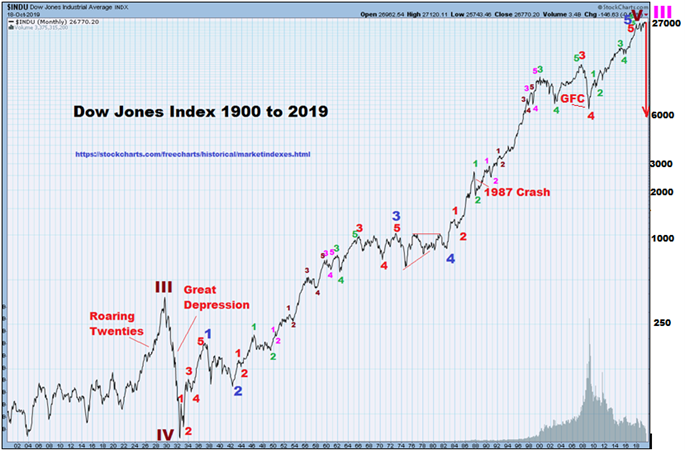
Take a look at the chart for the Dow Jones index over the last 100 years (above). Notice how since the April 1932 low the Dow has climbed to where it is today (October 2019) in five blue waves. Now notice how each of those blue waves is made up of (we say subdivides into) five red waves. And each red wave is made up of five green waves. And so on.
Now notice how the entire advance of the last 87 years (the five blue waves) is itself merely the fifth wave of an even larger degree, which I have shown as plum color (wave V). That fifth wave is only the final part of a five wave move of even larger degree (pink Roman numerals). A wave of optimism of huge degree is at or near completion and now has to be “corrected” with a large wave of pessimism, just as the bear market that began with the 1929 stock market crash corrected the crazy boom of the “roaring twenties.”
How far will the Dow fall? The bear market from 1929 to 1932 wiped nearly 90% off the index. Could that happen again? Of course it could.
Sometimes (but not always) a “correction” will take the market back to the region of the fourth wave of at least one smaller degree in the preceding bull market advance. Red wave 4 (two degrees smaller) bottomed below 6,500 points in 2009. With the Dow currently around 27,000 points, that would mean a fall of 75%. Could that happen? Of course it could.
But I think it could fall further than that. A pullback to the region of blue wave 4 (only one degree smaller) would take us back to the area of that great triangle in the 1970s. That would mean the Dow could fall from its current nose bleed area to around 1,000 points!
Would an economic depression follow such a catastrophic fall in the share market? Does night follow day?
Our Fatally Flawed Money System Has Passed Its Use-By Date
Where does money come from?
If you asked one hundred people where money comes from, who creates it, on what basis, and how does it get into the system, you would be lucky to find one person who could answer you correctly. For example, if there is $2 trillion in “circulation” now, but 20 years ago there was only $1 trillion, where did that extra $1 trillion come from? Who created it? Who put it there? How did they put it there? And on what basis was money added to the economy? Most would stare blankly for a while and then answer: “The government?” (By “money” I mean total money in bank accounts as well as notes and coins. Cash makes up less than 5% of money “in circulation” today. Most “money” is only an electronic entry on a computer at a bank).
If my question had been who should create money the answer would be “the government” (in my opinion). But that was not my question. Sadly, someone else hijacked that job a long time ago.
Very few people understand that banks create money out of thin air! If we tried it we would go to jail for counterfeiting. Banks do it “legally” every day.
This is no secret. Just read what the Bank of England admits here: https://www.bankofengland.co.uk/knowledgebank/how-is-money-created.
It’s just that it is not in the interests of those in control for you to be acquainted with or be frequently reminded of the greatest financial confidence trick ever perpetrated upon mankind. And it is made and kept as mysterious as possible so that you don’t bother trying to find out.
Even economists don’t question it. If you asked one hundred economists the same questions about where money comes from you would probably be very disappointed with the response. Some might try and blind you with verbose rubbish. Others would expose their utter lack of understanding of this subject, even though technically they were taught it in university (for about 5 minutes). When it comes to economic fundamentals this is the most important question that could ever be asked. Yet exponential debt, which is a consequence of this gigantic bank rip off, is largely glossed over by economists as they focus on things like supply and demand, GDP, interest rates, inflation, trade wars, retail sales, unemployment, political and geopolitical events, etc. etc.
The evil consequences of this gigantic fraud on humanity are horrific to contemplate. And the global economy is inching closer and closer towards the day of reckoning, when this heinous crime will be exposed. As I said earlier, the (deliberately) fatally flawed system has a use-by date. It has sewn within it the seeds of its own destruction.
The “Fractional Reserve” system
Our global money system is called fractional reserve banking. What that means is that banks are only required to retain a fraction, a small portion (about 10%), of deposits that they receive, in reserve. They can lend out the rest. And they can lend it out over and over. https://www.youtube.com/watch?v=-09ap6zIB6I
For example, say a customer deposits $100,000 in a bank. The bank lends out $90,000 to another customer who uses that money to pay yet another customer of the same bank who now deposits the $90,000 back in the bank. The bank can now lend out $81,000 (90% of that $90,000) to yet another customer who pays yet another customer of the same bank. That last customer now deposits $81,000, of which the bank can again lend out 90%. And so the process goes on. Theoretically that original $100,000 can eventually result in total loans of $1 million, even though not one dollar of new money has been deposited. It all came from that original $100,000 deposit (which a bank would have created out of thin air and put into the system by way of a loan in the first place). From the original $100,000 an additional $900,000 has been created “out of thin air” by way of more bank loans.
Of course, people use many banks, so it is highly unlikely that all of those transactions would occur within the same bank. But the banking system as a whole can create about ten times the amount of deposits they receive in new loans under the fractional reserve banking system.
The most evil consequence of this system arises because every new loan created by a bank has an interest bill attached to it. Banks don’t give money away. They lend it into existence. If $100,000 is lent out at say 10% per annum interest, even if the loan is repaid within one year $110,000 has to come back to the bank. Where does that other $10,000 come from? Only $100,000 in new money was created. The other $10,000 was never created as new money. It has to come from somewhere else.
More on that later. First …
The Origin of the Fractional Reserve Banking System
Where did this system come from?
The origin goes back to before the 17th century. There was no such thing as paper money, and no such thing as banks. People held their wealth in gold and silver and other precious or valuable assets. But they had nowhere to store their riches. If they traveled anywhere, they had to carry their wealth with them. Traveling was by horse drawn stage coach, so highwaymen had an easy time holding up coaches and extracting the valuables from the passengers. “Stand and deliver!” became a catch phrase. https://www.bbc.com/bitesize/guides/z2cqrwx/revision/4
Some highwaymen, like Robin Hood, became heroes because they “robbed the rich to pay the poor” (so they claimed). Even in early European settlement in America the experience of highwaymen holding up a stage coach and robbing the travelers is portrayed in many “western” movies set in the 19th century (e.g. Jesse James).
Why did people so foolishly carry their treasures with them when they traveled? Because they had no choice! There were no secure facilities where they could store their valuables. They had to carry them wherever they went.
Enter the Jewish Goldsmiths
Along came the Jewish goldsmiths, who built strong, secure vaults where people could deposit their gold and other precious items for safety. (These were the forerunner to banks of today). The goldsmiths gave people a receipt for their gold, and these receipts were “as good as gold.” So people started trading with the receipts rather than gold. These were obviously the forerunner to the bank notes we use today. In and of themselves these receipts were worthless pieces of paper. It is what they represented that was of value.
This was a pure “gold standard.” Every dollar (or pound) in circulation was represented by $1 or £1 worth of gold in the vaults.
In time the goldsmiths noticed that very few people ever came back to collect their gold. “Receipts” had replaced gold, etc. as “money.” So, with the consent of the owners they began lending money (in the form of “receipts”) to others who needed to borrow. They charged them interest, some of which they gave back to the owners of the gold. For example, if they charged the borrower 5% interest they might pay the depositor 2½%. The bank is simply an intermediary between borrower and lender, and takes a cut from the interest to cover their expenses of storing the gold and administering the loan and to make a profit.
But the Jewish goldsmiths were not honest. And they were greedy. After some time they thought to themselves: if we lent out more “money” than what was represented by gold in our vaults, who would ever know? The answer was: nobody. So that’s what they did. They began lending more money than was represented by gold in the vaults. When someone wanted a loan they didn’t even try and match it with gold in their vault. They simply created more “receipts” but added 5% interest to the amount that had to be repaid. And they didn’t even have to pay anyone 2 ½%! In time there was about ten times the amount of “money” in circulation as there was gold in the vaults.
These Jewish goldsmiths became fabulously wealthy. Think about it. If they lent out ten times the amount of money, on which they were paying 2½%, at 5% interest they were effectively earning 50% but only paying 2½%! And they didn’t even have to always pay the 2 ½%!
That is exactly what banks do today! That is why a banking license is regarded as “a license to print money.” That’s precisely what it is.
Central Banks
The first central bank was the Bank of England, which was founded in 1694 by the Scottish financier William Paterson, who served as one of its first directors. Paterson left the Bank after a year due to policy disagreements and control of the bank was taken over by the Jews.
This story actually begins in the mid 1500s when Jews took over Amsterdam after being expelled from Spain and Portugal during the inquisitions of the early 1500s - 1820s.
Many people forget that there were attempts at forming a central bank in the
United States in both 1791 and in 1816. And that the central bank of 1791 lasted
20 years and that congress’ unwillingness to renew the charter resulted in the
war of 1812.
The central bank of England for example, formed in 1694 after the
“Glorious Revolution” of 1688, played a pivotal role in Jewish interests in
regards to the slave trade in the Americas and the ultimate realization of their
plans to build central banks and “stock markets” like the one they created in
Amsterdam in 1602 and 1609.
The center of European banking moved from Amsterdam to London as a result of the
Glorious Revolution and the King of England having his authority transferred to
the already corrupt Parliament. The notorious “City of London” -- a sovereign
state within England -- became the center of world finance after Jewish banking
dynasties colonized it.
Right before this move was one of histories most infamous scams -- the “Dutch Tulip
bubble,” which enriched the newly formed financial sector in Amsterdam in the
1630s. The Jews would take that enormous wealth generated and put it towards
backing William of Orange in his quest to conquer England and steal the throne
from his father-in-law James II.
Once installed, the centuries long civil war in England fought over absolutism
and a kings “divine right to rule” came to an end, and authority to rule was firmly
placed in the newly formed Parliament that the Jews had control over. It wasn’t even
a decade later in 1694 that the Jews began to build their “institutions” in
London, their Central Banks, their Stock Markets, their lending houses all of
that which was tested in Amsterdam came to London. England would spread this new
form of “banking” to the colonies like a cancer.
The Federal Reserve Act of 1913 in the US was mischievously engineered by a group of already mega rich Jewish bankers so that they could entrench their control over everyone, including the government, and be enriched even further by a central bank, under the guise that the central bank had to be “independent.” “Politicians cannot be trusted to control money creation,” they said. “They will quickly begin creating too much money in order to buy votes and this would lead to inflation.” Their argument was that such an important job should be left in the hands of “independent” (?) banksters.
Today economists, politicians and the media focus on the Fed’s every word and action, thinking that everything from the share market to the gold price to the economy will be affected by what the Federal Reserve says and does (which is a nonsense anyway). Yet no-one ever questions the legitimacy of the Fed’s very existence. And very few realize that the Fed is not part of the US government. The Federal Reserve is owned by the banks controlled by the Jewish bankers!
Note that in some countries, such as England and Australia, the central bank is now owned by the government. The European Central Bank is owned by the big commercial banks, as in the US. The Bank of Japan is 55% government owned, and shareholders own the rest. It doesn’t make much difference who owns the central bank. Although they have enormous power, the central banks themselves don’t make large profits. It’s the commercial banks that make the big bucks. But given that the central bank controls the commercial banks, having the central bank owned by the banks themselves is no handicap for them.
The Evil Consequences of This Corrupt and Flawed System
Apart from creating an international cartel making banks obscenely rich, to the extent that they are more powerful than governments, and finance both sides in a war, the most serious consequence of allowing banks to create money out of thin air is that all money is loaned into the economy, with an interest bill attached, but the money to pay the interest on those loans is never created.
For example, if you borrow $100,000 from a bank and have to repay $110,000 with interest, where does that other $10,000 come from? It was never created. You would have to get that $10,000 from someone else who has borrowed it from a bank, because nearly 100% of all money comes into existence by way of a loan from a bank (i.e. created by a bank). As a consequence of this, there is never enough money in the system for everyone to be able to pay their debts. The system guarantees that some bank customers have to go bankrupt. But this is disguised during times of relevant prosperity and while everyone continues borrowing and spending.
The survival of this system depends on more money being borrowed from banks than money being repaid to banks at any one time. Unless this happens the amount of money left in the system will keep reducing until serious economic consequences result. That is why banks will always lend money to a willing borrower who can put up satisfactory collateral security of more than 100% of the loan being applied for.
Let me illustrate this by means of a deliberately over simplified illustration.
In the beginning were Adam and Eve and a bank. The bank loaned Adam and Eve $100,000 at 10% interest. At the end of the first year Adam and Eve wanted to repay the bank both principal and interest, a total of $110,000. But there was only $100,000 in existence. There was nowhere they could get the other $10,000. It had never been created.
OK, that won’t work. Let’s try again. Fast forward a few years. Adam and Eve have borrowed $100,000 again. Now Cain and Abel have each borrowed $100,000 from the bank as well, on the same basis -- 10% per annum interest.
So Adam sells $10,000 worth of apples and fig leaves to Cain and Abel (e.g. $5,000 to each). Now Adam can repay the bank the $110,000 he owes them.
But now Cain and Abel have a problem. At the end of the first year they will owe the bank a combined $220,000 (2 x $100,000 plus the first year’s interest of 10%), but there is now only $190,000 in circulation (the $200,000 they borrowed less the $10,000 paid to Adam, which he repaid to the bank). So already the shortfall is $30,000, after just one year.
Can you see how the longer this system goes on the less money there will be in circulation, unless the bank can keep pumping out new loans to customers faster than loans (or even interest) are being repaid? (How banks must love immigration and population growth!)
While everyone is in optimistic mood they will borrow and spend and so the flawed system survives and no-one finds out about it or understands it. The system depends for its survival on the confidence and the optimistic mood of the public. If depositors knew how unsafe their money really is in a bank they would all run to withdraw it, and that would bring the banks crashing down, because the banks have lent out their money ten times over, so they have no hope of meeting all withdrawal requests. But governments, with the help of the media, keep reassuring us that the banking system is sound and well controlled and regulated, and we can have confidence that our money is safe, etc. blah, blah, blah, which is really a lie. The reality is that the whole thing is a confidence trick! But until the music stops, as long as people keep borrowing and spending and racking up more and more debt, the doomed system continues, but with debt (to the banks) rising exponentially.
The problem arises when crowd optimism changes to pessimism, which is inevitable. As I pointed out earlier, “herd” mood is cyclical. When people begin to fear that they won’t be able to pay their bills (e.g. if unemployment rises and they fear losing their job) they pull in the belt and stop borrowing and spending and start saving money and repaying loans as much as they can. This is why central banks are focused on “full employment.”
Because of the socionomic force that drives the herd this becomes contagious. Everyone starts doing the same thing at the same time. Suddenly the wild borrowing and spending of the past changes to saving and “deleveraging” (which is the latest buzz word for repaying loans). This sucks vast amounts of money out of the economy (and back to the banks, which extinguish it, just like the Post Office cancels a postage stamp so it can’t be used again) until suddenly there is not enough money to keep the economy going. There is not enough money for people to pay their debts, and the financial system and the economy grinds to a halt, as wealth is destroyed, with many individuals falling into bankruptcy and corporations falling into receivership and liquidation. All because of a deliberately flawed fraudulent money system!
Think about this: In the Great Depression of the 1930s was there a shortage of resources? Was there a shortage of goods and services? Did crops and livestock and vegetables and fruit suddenly stop growing? Did the rain stop falling and the sun stop shining? Of course not! Was there a shortage of manpower or intellect? Hardly; the unemployment rate went up to 25% and higher in many countries.
So what was in short supply? Money. That’s all. Only money. And that was because the fraudulent system that was established less than 20 years earlier failed. During the “roaring twenties” optimism abounded and people borrowed and spent like there was no tomorrow. But then the mood changed to pessimism, and money was sucked back out of the system as the borrowing and spending mentality changed to saving and repaying debt. Just like now the dumb public did not even realize that the very system that was supposed to protect them from a calamity such as this had actually caused it. The promoters grew only richer while the public grew only poorer.
Why do we need money?
As I have explained many times, money is not a resource. What do I mean by resource?
There are natural resources and human resources. Natural resources include fertile land, sun, rain, wind, animals, forests, minerals and energy sources under the ground and oceans, etc. Human resources include intellect and manpower, which combine to harness natural resources and turn them into food, clothing, shelter, and other goods and services we need to enjoy life on this planet, including roads, schools, hospitals, etc. Money is only a vehicle that is used to transfer the value of those resources from one person to another. It has no value in itself. Its value is in what it represents, just like the “receipts” that the Jewish goldsmiths produced to represent gold.
In my book I used the illustration of one hundred people shipwrecked on an island, unable to communicate with the rest of the world. They virtually have to start civilization anew. They come from all walks of life. Their number may include farmers, carpenters, doctors, lawyers, clerks, salespersons, teachers, accountants, nurses, policemen, plumbers, you name it. How are they going to trade with each other?
The barter system would not work. If the potato farmer needs the carpenter to build him a house, how will he pay him -- in potatoes? How many potatoes can a carpenter and his family eat before they go rotten? And what will the carpenter use to buy timber and bricks and to pay his laborers? And how does a school teacher or a nurse pay a plumber? Clearly they need a medium of exchange, something that they all accept as representing the value of the labor or produce or expertise that they exchange with each other. And that is the function that money serves. It is a medium of exchange, a store of value, and a unit of account. It represents resources.
It doesn’t matter what money is made of. Money in and of itself has no value. It does not need to be gold or anything else of value. It is what money represents that is of value. As long as everyone accepts that “money” represents their goods and services and assets, it can be pieces of paper. And governments can force people to accept pieces of paper as “money,” as the medium of exchange, by passing a law that says those pieces of paper are the only form of “legal tender.”
Why is it so complicated?
There needs to be enough money in circulation at any time to represent all the things of value in the economy, including the goods and services produced and the assets built and stored. How much is enough? That’s where it becomes complicated. For example, going back to my illustration, let’s say the teacher pays her accountant $100 who then pays the plumber $100 who then pays the lawyer $100 who uses it to repay a bank loan. Once it is back “in the bank” it is out of “circulation.” So for a time that $100 needed to be in circulation, but not forever. But then the potato farmer digs up his crop, which is worth $1,000. So now there needs to be new money created to represent this $1,000 worth of potatoes. And that $1,000 will also change hands many times. This is called the “velocity” of money.
As I said, there needs to be enough money in circulation at any time to represent all the things of value in the economy at any one time.
The big questions are: How much is enough? Who is going to put that money there (and take it back out)? How should it get there? Who decides how much there should be? What basis do they use for deciding how much?
If more money than “stuff” is created, it will lead to inflation of prices. If not enough money is put into the economy to match the “stuff” produced it will lead to economic slowdown and deflation.
Take note of what former Federal Reserve chairman Alan Greenspan said as former US Republican House Speaker Paul Ryan quizzed him on the question of privatizing retirement benefits because Social Security is grossly underfunded. Greenspan said:
"There’s nothing to prevent the Federal Government from creating as much money as it wants and paying it to somebody. The question is: how do you set up a system which assures that the real assets are created which those benefits are employed to purchase … It’s not a question of security; it’s a question of the structure of the financial system which assures that the real resources are created for retirement, as distinct from the cash. The cash itself is nice to have, but it’s got to be in the context of the real resources being created at the time those benefits are paid so that you can purchase real resources with the benefits, which of course are cash." (https://www.youtube.com/watch?v=DNCZHAQnfGU).
Do you get what he meant there? It is profound. It is typical Greenspanspeak, so it is not easy to follow. But what he meant was that the scare campaigns about federal government deficits, and the national debt, and about Uncle Sam running out of money long before the people currently paying into Social Security retire, are bogus. “The Government” can create as much money as it wants (Note again: “The Government does not create any money. The banks create the money and lend it to the government, with interest).
The important question is whether or not there will be enough resources, like food, clothing, shelter, hospitals, medicine, medical care, leisure activities, etc. available for them to spend their pension payments on when they retire. That’s where the focus and the debate should be. If those things are not in place those pension payments will cause inflation. But as long as the resources are there for retirees to spend their money on those payments will not cause inflation. The amount of money in circulation needs to match the “goods and services” produced and the assets in existence (the “stuff”) at any one time.
Although it may not have sounded like it, Greenspan was actually talking sense; real sense. Of course he was not going to go further and confess to the real problem with the money system, namely that money is created by banks and loaned into existence, with an interest bill attached, instead of being spent into existence by “the government,” interest free. But he went further than Paul Ryan, for one, expected; much further.
Let me repeat: Money is not a resource. It is only used to represent resources. A shortage of money should never occur. And it certainly should not affect the economy. The amount of money in the economy should be increased or decreased according to the needs of the economy. And it should not have an interest bill attached! Yes, it should be controlled by some authority that is “independent” of politicians. But that “someone” should not be obscenely rich Jewish bankers who create money at their whim and for their own benefit. These are the ones who convinced everyone (including politicians) that politicians could not be entrusted with the creation of money! They are hardly “independent” themselves!
New Money Should Not Enter the Economy With an Interest Bill Attached!
The “Global Financial Crisis” of 2008
A drying up of money supply is what happened during the “global financial crisis” in 2008. Banks had so much debt and risky assets that they didn’t even trust each other any more! In panic they stopped lending, even to each other! Lending just stopped; everywhere. There was no new money being created. The music stopped; virtually overnight! So suddenly there was a drastic shortage of “money” in the system.
So what did the “banksters” do, (once weak-kneed and/or ignorant US politicians used Taxpayers’ money to bail them out?) They created even more money! Central banks around the world slashed interest rates to zero in a vain attempt to encourage people to keep borrowing and spending. Then they added trillions of dollars to the liabilities side of their balance sheets by creating it out of thin air and using it to buy government bonds etc. (“quantitative easing.”)
But all this has done is to kick the can down the road. The issue will still have to be addressed later. Now the end result is going to be much worse, because all that new money is new debt that will have to be repaid down the track, plus interest, along with the insurmountable mountain of debt that caused the problem in the first place. And all of this debt is owed to banks. And in the process massive “bubbles” have been created in asset prices everywhere -- shares, houses, gold, oil, you name it.
Can you see how our flawed debt money system has a use-by date? The time must eventually come when people stop borrowing and spending and the amount of new money being created shrinks. And that is what is happening now, as the long wave of optimism since the last Great Depression comes to an end and gradually metamorphoses into what will be a long wave of pessimism.
The fatal flaw in our current fraudulent system will be exposed when there is not enough money left to run the economy, as borrowing and spending gradually changes to saving and “deleveraging.” Try as the banksters might to keep people borrowing and spending, with “creative” new ways, eventually it won’t work. They will be “pushing money on a string.”
To me it is not rocket science. The current money system is flawed because it was designed by Jewish banksters for Jewish banksters! They hijacked the money creation system in the US in 1913. And no-one seems to even understand that, let alone acknowledge that this is the main cause of economic instability and inequality in the world today. None of the “experts” ever even mention it. Not even in passing.
The elephant in the room is interest charged by banks! It is the evil consequence of our fraudulent debt money system.
Think about it.
When was the Federal Reserve Act (which is unconstitutional and has never been ratified by 75% of the states to make it constitutional) enacted? 1913.
When was income tax introduced in the US? 1913. Duh!
Why was income tax introduced? So that the US government could pay interest on the money it borrowed from the Jewish banksters who created it out of thin air! The success of the banksters’ financial coup d’état of the money system depended on rigging the system so that they got paid. One can only imagine the corrupt payments that must have changed hands for politicians to agree to such a gigantic swindle.
And you believe the media BS that the poor little tradesman who asks you to pay him in cash is a “tax cheat,” and that if you dob him in to the Tax Man you are doing a good thing? How deceived and brainwashed and warped in our thinking we have become! The struggling tradesman is not the tax cheat. The real tax cheats are the banks! As are the weak kneed and/or ignorant politicians who allow them, for whatever reason, to control the creation of money and charge interest on it! They are the real “tax cheats!”
The writing is on the wall already. In the last decade, the frantic efforts of central banks around the world to keep pumping new money (new debt) into the system has not worked. Zero interest rates, and even negative interest rates in some countries, along with trillions of dollars and euros and yen in “quantitative easing” has still not resulted in “economic recovery.” In fact, there is widespread talk of recession in Europe, the Chinese economy has been slowing down for years, and now India is slowing too, and the performance of the US economy has not been all that flash, despite the obscene amount of new debt created.
Why is this? Economists are scratching their heads. At this late stage of the “business cycle” time is running out for “monetary stimulus” to work. And governments around the world have tipped in with tax cuts and infrastructure spending to help “kick start” the economy. But this has only left governments with unprecedented “public debt” of their own. This unprecedented coordinated global effort has not worked. Why hasn’t it worked?
It is not rocket science. But the highest paid brains in the world can’t see it.
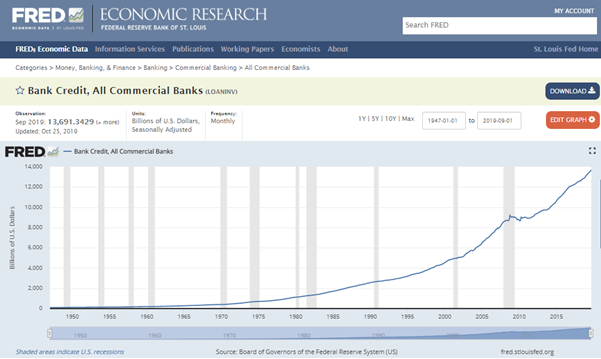
Here is why it is not working. Just look at the graph below.
|
|
I have been unable to get figures for the whole world, but this is the amount of debt owing to banks in America. Can you see why I call it exponential debt? Apart from the slight hiccup during the dress rehearsal for the next Great Depression, which we saw in the “global financial crisis” in 2008, outstanding bank “credit” (which means debt) has been rising exponentially since the last Great Depression, as the herd has been in optimistic mood.
And although it is a different subject, during this time the rich have got ever richer and the poor have got poorer. The great chasm between the rich and the poor is also a product of this shameful system. I can’t resist referring you to this clip of Congresswoman Katie Porter grilling JP Morgan Chase CEO Jamie Dimon on the reality of life in America as a consequence of our fraudulent debt money system, even before the Coming Great Depression. Yet even she doesn’t understand the reason for the debacle. (I would doubt that Dimon doesn’t). https://www.youtube.com/watch?v=yh4nhkuvuFc
I digress again, but how many bank CEOs went to jail for the $US30 trillion in global wealth that was destroyed as a consequence of the “GFC?” The answer is not one.
But how much have banks paid in fines? $US320 billion!
Win-win! Easy money for banks to create; easy money for governments to accept. Beats the heck out of raising taxes; and beats the heck out of going to jail. What a cosy arrangement! And almost no-one can see it.
Even if “herd” mood was not in the process of metamorphosing into pessimism after nearly a century of optimism this would be problematic. An airplane that climbs like this must eventually reach the point of stall. And we know what happens when it reaches that point.
But herd mood is reversing. Our fatally flawed debt money system has passed its use-by date. The evil consequences of all that dishonest interest paid to banks over all those decades is about to be exposed. The fallout is horrific to contemplate.
At the beginning of this article I said:
"The next “Great Depression” is not a matter of “if.” It is only a matter of “when.” And all indications are that it will be sooner rather than later."
Two things combine to make a historic global economic downturn a certainty. Each on its own is sufficient to create havoc in financial markets that will lead to devastating consequences for the economy. Put them together and they become a lethal cocktail for which there is no antidote.
I hope you can now see why I said that.
("You shall not charge interest to you brother [fellow Israelite] -- interest on money or food or anything that is lent out at interest. To a foreigner you may charge interest, but to your brother you shall not charge interest, that the LORD your God may bless you in all to which you set your hand in the land which you are entering to possess" (Deuteronomy 23:19-20)).
|
Hope of Israel Ministries -- Warning YEHOVAH's People Israel of Events Leading Up to the Kingdom of YEHOVAH God! |
|
Hope of Israel
Ministries |
|
Scan with your Smartphone for more information |